
PLM vs ERP: Key differences and which system your business needs in 2026

For product-led businesses, PLM and ERP are two of the most important systems. But, they’re often misunderstood, or confused with one another.
In short:
- PLM – Product Lifecycle Management – manages the creation of your products.
- ERP – Enterprise Resource Planning – manages the operation of your business.
And, if you’re comparing PLM vs ERP software and feeling unsure about which you need, you’re in the right place.
In this guide, we provide a clear explanation of PLM and ERP, outlining everything you need to know and the key differences, so you can make an informed decision on how to move forward with your brand.
What is a PLM system?
Product Lifecycle Management manages everything about your product – from the first sketch to when it hits shelves. Think design, development, sourcing, production, compliance and suppliers.
PLM is typically used by designers, developers, QC teams, production teams, buyers, merchandisers and sourcing roles.
With a good cloud based PLM, you can answer questions like:
- Where are we in the product development process?
- What’s the latest version of this design?
- Which supplier is approved for this material?
- Is this product compliant?
- What’s holding up our range?
Everyone is aligned, everyone is pushing towards the same goals, and your products are moving forward.
The global PLM market is projected to reach USD 34.66 billion by 2029 and 56% of manufacturing companies report that investing in PLM software reduced their product development time by at least 15%.
Source: https://www.fortunebusinessinsights.com/semiconductor-market-102365
What is an ERP system?
Enterprise Resource Planning manages your business processes, such as inventory and stock, purchasing, warehousing, financial accounting, invoicing, sales and sometimes even HR.
ERP is used by finance, operations, logistics and inventory teams to answer questions like:
- What stock do we have?
- What’s our financial performance this month?
- How many units are we purchasing?
- What are our current sales orders?
The global Enterprise Resource Planning (ERP) software market was valued at USD 54.76 billion in 2022 and is expected to reach USD 93.34 billion by 2028.
Source: https://www.statista.com/statistics/203428/total-enterprise-software-revenue-forecast/
Core differences between PLM and ERP systems
PLM and ERP complement each other, but they’re not interchangeable. There are key differences between PLM vs ERP systems.
While PLM helps you bring your product from concept to market, ERP helps you deliver it efficiently and profitably.
See some of the key differences below:
Data types
PLM
Detailed, creative and technical information, required to build a product from the ground up. Designs, BOMs, materials, specifications, lab tests, supplier certifications, approvals, fit samples, costings and tech packs.
ERP
Transactional and operational data, such as stock levels, sales orders, production quantities, purchase orders, invoices and shipping information. ERP ensures this data is accurate and up to date.
Users
PLM
Designers, developers, garment technologists, QC teams, buyers, merchandisers and sourcing professionals rely on PLM to stay aligned, track changes, collaborate with suppliers and ensure every product is built correctly.
ERP
Finance teams, operations managers, logistics specialists, warehouse staff and inventory controllers use ERP to manage stock, track orders, process invoices and keep financial and operational data consistent across the organisation.
Objectives
PLM
Helps your business create products faster, more collaboratively and with fewer errors. Provides clarity across the development process, ensures product data stays accurate and connected and reduces manual admin.
ERP
Helps your business deliver products efficiently and profitably by centralising financial, operational and inventory information. You can plan production accurately, maintain healthy stock levels and manage supplier purchasing.
When to choose PLM over ERP
PLM is the right investment for businesses that are heavily involved in product design or development.
If your product team spends lots of time managing detailed specifications, multiple materials, frequent sampling rounds, testing requirements, or fast-moving product updates, PLM provides the structure and visibility that ERP cannot.
Does this sound familiar?
- We manage complex product data
- We work with multiple suppliers
- We want faster development cycles
- We struggle with version control
- We’d love better visibility across multiple teams
PLM is the system that fixes those pain points.
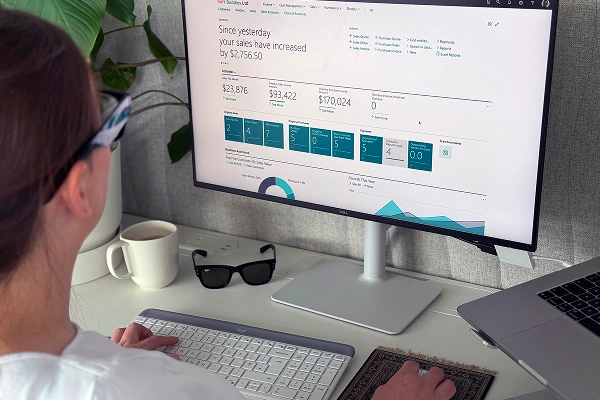
When ERP makes more sense than PLM
ERP should be a priority for businesses that are service-based or without in-house product development.
If your team is a consultancy or agency, or has highly standardised production without complex development cycles, start with ERP first.
Does this sound familiar?
- We focus on operations, logistics or finance
- We have stable or unchanged product ranges
- We need visibility on our inventory
- We want to consolidate financial data across multiple locations
ERP can unify all of this information for you.
Can PLM and ERP work together?
Yes – PLM and ERP can work well together and some businesses benefit most when the two systems are integrated.
PLM takes the lead in the early stages, guiding your teams through product creation, design iterations, sourcing decisions, cost negotiations, samples, testing and approval workflows.
Once the product is fully defined and ready for production, that information naturally flows into your ERP system, where it becomes the foundation for purchasing, inventory planning, stock management, financial reporting and order fulfilment.
When the two systems are integrated, you benefit from one connected workflow:
- Product teams can innovate quickly
- Operations teams produce efficiently
- Finance gets visibility into costs and performance
- Data stays accurate across both systems
Bombiix is built with integration in mind. Its API-friendly structure makes it easy to connect with common ERP systems, reducing manual work and ensuring data consistency across your business.
Making the right choice for your business in 2026
In summary, choosing between PLM and ERP comes down to these factors:
Your product complexity
- More variants, materials and suppliers? Go for PLM.
- Stable, unchanged product ranges? Go for ERP.
Your team's pain points
- More variants, materials and suppliers? Go for PLM.
- Stable, unchanged product ranges? Go for ERP.
Your growth stage
- Product-led startups and scale-ups – PLM first.
- Scaling brands – both PLM and ERP but PLM unlocks earlier wins.
- Enterprises – Integrated PLM and ERP.
Who struggles the most day-to-day?
- If your product team feels overwhelmed – choose PLM.
- If your operations or finance team struggles – choose ERP.
PLM vs ERP FAQs
In case we missed anything above, below are some frequently asked questions about ERP vs PLM.
Can small businesses benefit from PLM software?
Absolutely. Modern PLMs are designed for teams of any size and don’t require large IT setups. They help small teams work faster and with fewer errors.
How long does PLM implementation take?
It depends. Some PLM systems can take 6-18 months. Bombiix is typically implemented in 3-6 months.
Do I need both PLM and ERP?
If you create products and manage inventory, yes. Both systems combine to support different parts of the business and this work best when integrated.
What's the cost difference between PLM and ERP?
ERP is typically more expensive upfront due to implementation and infrastructure costs. PLM is usually lower cost, especially cloud PLM, with faster ROI.
Which system should I implement first?
If product development feels chaotic, choose PLM. If stock, finance or purchasing feels disorganised, choose ERP. Many brands start with PLM because it unlocks early efficiencies across teams.