









Pattern grading is the process of proportionally scaling a sample pattern (typically size 8 or 10 in the UK) up and down to create a complete size range. Establishing rigid pattern grading standards is the single most critical factor in maintaining consistent fit, protecting brand aesthetics, and controlling production costs across medium-to-large size runs.
Without standardised grade rules, sizing discrepancies compound during factory grading, which can lead to ill-fitting garments, inflated return rates, and costly sample revisions. This guide outlines how product managers can formalise grading specifications, communicate clear dimensional jumps to suppliers, and audit graded nests to eliminate fit errors before bulk cutting begins.
| Production Metric | Impact of Standardised Grading |
| Fit Consistency | Eliminates size-to-size proportion drift across factories |
| E-Commerce Returns | Reduces fit-related product returns by up to 30% |
| Sampling Lead Time | Cuts pre-production sample approval rounds from more than 3 to 1 |
What is pattern grading: and why does it matter at scale?
Pattern grading is the precise method of proportionally increasing or decreasing a base-size sample pattern (UK 10) to create a complete size range (such as UK 6 to 18). Rather than altering a design's original look, grading applies specific dimensional increases (grade rules) to chest, waist, hip, and length points to preserve the exact silhouette and fit balance across every size in a clothing range.
This makes accurate grading critical at a commercial scale. If something as small as a minor 2mm error is applied incorrectly to a waist point on a base pattern, it can compound rapidly across a 6-size run, and result in a 12 mm distortion on a size 18 garment. Multiply that flaw across a production run of 5,000 units, and the result is widespread fit failure, inflated customer return rates, and wasted stock. Standardised grade rules protect your sizing integrity across multiple factories and supply chains effectively.
A brief history of pattern grading standards
Pattern grading originated in the 19th-century, where master pattern cutters manually scaled base slopers using physical nesting techniques on paper. As mass manufacturing expanded post-WWII, the lack of uniform sizing created chaos for retailers, driving the development of national anthropometric surveys and formal standards like BS 3663 and ISO 8559.
The transition from physical grade cards to digital CAD systems (such as Gerber and Lectra) in the late 20th century transformed grading into an automated, vector-based workflow. For modern product managers, understanding this evolution highlights why standardised digital grade rules exist today: they replace subjective manual adjustments with precise, repeatable mathematical parameters across global supply chains.
Pattern grading methods compared: cut & spread, pattern shifting, and computer grading
Apparel production teams use three primary grading techniques. Choosing the right method to use depends on your operational scale, budget, and design complexity.
1. Cut and spread method
- How it works: The physical base-size pattern is cut along pre-determined horizontal and vertical grid lines. The pieces are then spread apart or overlapped by specific measurement increments (grade rules) and taped to paper to draft the new size.
- Best used for: Traditional hand-patternmaking, bespoke tailoring, or simple design modifications.
- Pros: Highly visual; straightforward to teach and execute without digital tools.
- Cons: Extremely time-consuming; high potential for human error; difficult to store and replicate physical paper grade nests across multiple factories.
2. Pattern shifting method
- How it works: The original base pattern is traced onto paper, then shifted a set distance along an X/Y axis grid based on specific increment coordinates. The new size contour is redrawn section by section at each shifted position.
- Best used for: Rapid manual sample adjustments and small-batch production runs.
- Pros: Faster than cut and spread; does not require cutting up the original base pattern master.
- Cons: Prone to accumulative drawing errors; requires skilled technical pattern cutters to preserve curve integrity.
3. Computer grading (CAD)
- How it works: The base pattern is digitised into specialised apparel CAD software (such as Gerber or Lectra). Technical designers input numeric grade rules (X and Y offsets) at specific points, allowing the software to instantly generate the entire graded nest automatically.
- Best used for: Commercial production, multi-factory manufacturing, and enterprise apparel brands.
- Pros: Instantaneous precision; seamless integration with digital tech packs and automated fabric markers; eliminates manual math errors.
- Cons: Requires specialised software licensing and trained technical staff.
Method summary at a glance
| Grading Method | Operational Speed | Precision Level | Best Suited For | Scale Suitability |
| Cut & Spread | Slow | Moderate | Bespoke / Sampling | Low |
| Pattern Shifting | Moderate | Moderate | Small-batch boutique | Low-to-Medium |
| Computer Grading (CAD) | Instant | Maximum | Commercial production | High (Enterprise) |
Pattern grading standards: grade rules and x/y axis mechanics explained
A grade rule defines the exact distance and direction a specific pattern cardinal point moves to scale from one size to the next. In digital CAD systems and technical spec packs, these movements are mapped using a two-dimensional coordinate system (X and Y axes) applied to each Point of Measure (POM).
The X/Y axis coordinate framework
- X-axis (Horizontal / Width): Controls circumference, width, and horizontal distribution (e.g., chest width, waist width, shoulder slope span).
- Y-axis (Vertical / Length): Controls vertical length, drop, and height shifts (e.g., total body length, armhole depth, neck drop).
Grade distribution logic & total growth
Total garment growth is split across pattern cardinal points. Because a front or back pattern piece typically represents one half of a symmetric garment, circumference increases are distributed proportionally across both side seams and centre lines.
- Total Circumference Jump: The overall growth required around the body between sizes (e.g. 40mm total chest jump).
- Pattern Piece Split: Divided equally across front 20mm and back 20mm.
- Half-Pattern Point Offset: Divided between the centre front/back line (0mm shift) and the side seam (20mm shift on the X-axis).
Worked example: grading a UK size 10 to size 12 chest
To scale a base UK size 10 womenswear jacket front panel to a UK size 12 using a total chest circumference jump of 40mm and a total body length jump of 10mm:
Quarter-Pattern X-shift = Total Circumference Jump, divided by 4. Which is 40mm divided by 4, which equals 10mm
Total Y-shift = Garment Length Jump = 10mm
| Pattern Point | X-Axis Shift (Width) | Y-Axis Shift (Length) | Technical Application |
| Center Front / Hem | 0.0mm | -10mm | Maintains straight grainline; extends lower hem |
| High Point Shoulder (HPS) | +2.5mm | +2mm | Expands neck width; raises shoulder height |
| Across Shoulder Point | +5.0mm | +2.0mm | Increases shoulder span |
| Underarm / Side Seam | +10.0mm | -3.0mm | Delivers full 10mm chest width increase; lowers armhole |
Documenting grade specs in tech packs
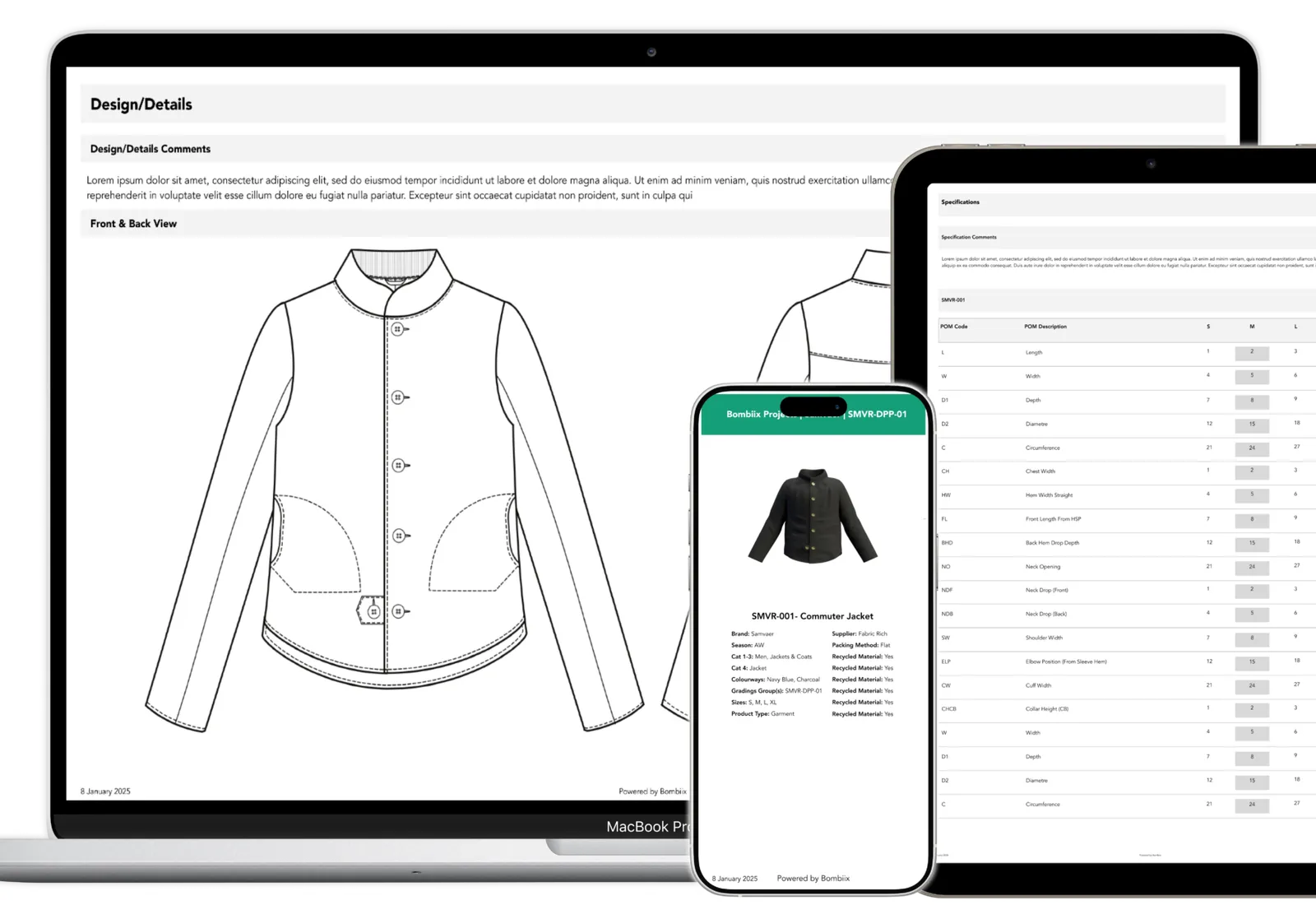
To ensure factory compliance, grade rules are codified into a Grade Rule Table within your digital tech pack. This table links each POM code directly to its corresponding X/Y coordinates.
E.g. POM Code: CH-01 > Chest Width > Base Size 10: 480mm > Grade Rule: +20mm per size
By establishing these strict mathematical offsets, product managers can prevent factory pattern cutters from making subjective adjustments during pre-production nesting.
How grade rules differ by garment category
Grade rules are never universal. They must adapt directly to fabric elasticity, structural drape, and end-use mobility. For instance, a rigid denim jean requires precise X/Y increments (typically a 25mm waist jump per size) to maintain mechanical fit, whereas a high-stretch performance knit might use a reduced 15mm waist jump due to fabric elongation. Applying a rigid woven grade rule to a stretch jersey garment results in excessive bagging and lost recovery across larger sizes.
What grading cannot fix: common misconceptions
Pattern grading is strictly a proportional scaling tool; it is not a design or fit correction mechanism. Product managers often make the mistake of attempting to resolve underlying garment flaws through grade adjustments.
- It cannot fix a flawed base sample: If your UK size 10 base pattern suffers from balance issues, drag lines, or restricted mobility, grading will simply multiply those structural defects across your entire size run.
- It cannot compensate for fabric variance: Grading assumes identical material behavior across all sizes. It cannot account for differences in shrinkage or weight when switching from a base fabric to a lining or alternative colourway.
- It cannot replace a true size spec review: Applying a uniform mathematical grade across an entire range ignores body shape shifts, and does not account for things such as proportional hip-to-waist ratios in plus-size grading, which require dedicated split-grade rules rather than simple linear extrapolation.
Centralise your grade specs in one workflow
Bombiix centralises grade specs, tech packs, and size approvals in a single, secure workflow. This means that product managers don’t have to chase outdated spreadsheets across global factories.
CAD tools used for computer pattern grading
Leading CAD systems automate vector-based grading, allowing product managers and factory pattern cutters to apply digital grade rules instantly across complex style nests.
- Gerber AccuMark (Lectra): The long-standing industry standard for enterprise apparel manufacturers, widely used for high-volume pattern grading, automated marker making, and cut-planning.
- Lectra Modaris: Preferred by European fashion houses and luxury brands, offering advanced 2D/3D pattern creation alongside precise grading tools.
- Optitex (EFI): Popular among mid-market brands and activewear manufacturers due to its fast 2D grade-rule engine and seamless 3D virtual sampling integration.
- Tukatech (TukaCAD): Widely adopted by independent apparel brands and quick-turn factories for its user-friendly interface, built-in grade rule templates, and open-format file compatibility.
The cost and returns impact of grading errors
Inaccurate pattern grading directly undermines profitability. Sizing and fit discrepancies account for over 50% of all online apparel returns in the UK fashion sector. When a factory misinterprets a grade rule or applies inconsistent increments across size steps, the financial damage extends far beyond an isolated return shipping fee.
The true financial cost of poor grading
- Escalating return logistics costs: Processing a returned garment in the UK costs fashion retailers an average of £10 to £20 per item in inspection, repackaging, and shipping expenses.
- Margin erosion through discounting: Returned garments frequently miss their full-price sales window, forcing heavy end-of-season markdowns or write-offs.
- Pre-production delay costs: Incorrectly graded initial samples require multiple re-sampling rounds, delaying factory production slots and causing missed delivery windows.
The ROI of standardised digital grade rules
Establishing rigid, central grade specs within your PLM system transforms sizing from a liability into a competitive advantage:
- 30% reduction in fit-related returns: Consistent sizing across product categories builds customer trust, encouraging repeat purchases and lowering return volumes.
- Single-round sample sign-offs: Standardised digital grade rules allow factories to produce accurate graded nests on the first attempt, cutting pre-production lead times by weeks.
- Protected brand equity: Maintaining proportional fit integrity across all sizes ensures inclusive, reliable fit across your entire customer base.
How PLM software standardises pattern grading for product managers
Managing pattern grading via disconnected spreadsheets and endless email chains is a big source of pre-production friction. When measurement specs, increment updates, and supplier feedback live across separate files, factory miscommunications become inevitable, and result in costly sample re-runs, inconsistent sizing, and delayed production slots.
Our fashion-friendly PLM eliminates this administrative burden by centralising your entire sizing architecture into a single, cloud-based platform.
- Centralised grade rule libraries: Store master grade specs by garment category, establishing a unified source of truth across all design and technical teams.
- Real-time spec updates & version control: Every measurement adjustment or grade-rule tweak updates in real time with complete version history, preventing factories from working off outdated tech packs.
- Seamless supplier collaboration: Share digital tech packs, receive instant measurement feedback, and sign off on graded sample nests within a single connected workflow.
By uniting tech packs, grade specs, and factory approvals under one roof, Bombiix removes the guesswork from pattern grading. This allows you to deliver consistent, high-quality sizing to the market faster.
Frequently asked questions about pattern grading
What is a grade rule in pattern grading?
A grade rule is a precise mathematical increment that determines how much a specific pattern point shifts along the X (width) and Y (length) axes to scale between sizes. Mapped to specific Points of Measure (POM), grade rules ensure proportional growth across a size range while maintaining the original design's balance and silhouette.
What is the difference between pattern grading and pattern altering?
Pattern grading scales a balanced base pattern proportionally across a standard size run while preserving the original design. Pattern altering modifies specific measurement points on a single pattern to fit a specific individual body shape or bespoke proportion.
Which CAD software is most widely used for pattern grading?
Gerber AccuMark and Lectra Modaris are the leading enterprise platforms, with Gerber dominating North American supply chains and Lectra widely adopted across European fashion houses. Optitex and Tukatech are also extensively used by mid-market brands, independent designers, and quick-turn apparel manufacturers worldwide.
How do grading errors affect return rates?
A miscalibrated grade rule replicates fit defects across every single unit manufactured in that size step. When key measurement points drift out of proportion, garments fail to fit true to size. This drives up customer return rates, which account for over 50% of online UK fashion returns, and generates costly inventory price reductions.
Can PLM software manage grade specs and size approvals?
Yes. Modern PLM platforms like Bombiix centralise master grade rules and digital spec sheets alongside your tech packs. This provides version-controlled updates, real-time supplier access, and integrated sample approval workflows, which removes the need for email threads and manual spreadsheet updates that typically cause measurement spec drift across factories.
What is the difference between a grading group and a grade spec sheet?
A grading group is a master template of predefined X/Y increment rules applied to an entire product category (such as woven trousers). A grade spec sheet is the style-specific document within a tech pack that records the resulting absolute measurement value for every Point of Measure (POM) across all sizes.