We invested in Bombiix because we recognised the strength of its PLM offer and the impending EU requirement for Digital Product Passports.
With decades of experience investing in SMEs – from starting at 3i, to opening the Bahrain Development Bank and now co-owning Anticus – I’ve seen the challenges businesses face and the opportunities that come with them. Our role is to be a supportive investor, guiding Lucy in growing Bombiix and in future fundraising.

With experience across manufacturing, financial services, SaaS, e-commerce, and retail, I help Bombiix navigate growth while keeping a close eye on cash flow, performance and strategic alignment.
From the first time I met Lucy, I knew I wanted to work with her – she’s a breath of fresh air and the passion that fills her is infectious. It’s a pleasure to complement her skills in delivering the vision of Bombiix.
I make sure our software meets your needs, spotting areas for improvement and helping your team streamline and grow.
Having worked in hospitality, manufacturing, supply chain and agriculture, I bring a wealth of experience when it comes in creating digital solutions that tackle real-world challenges.
I joined Bombiix after being a customer – it’s hugely refreshing to see a platform that focuses on the needs of product people. After managing many global teams across multiple industries, including pharmaceuticals, FMCG, toiletries and cosmetics, sporting goods and apparel and fashion, I can see real potential in Bombiix, and I’m excited to lead the business and achieve it.
My experience is in garment technology, pattern cutting, product development and technical design and I understand the everyday struggles our customers face – the chaotic workflows, confusing email threads and out of date spreadsheets. So I created Bombiix to change all of that.
The concept for Bombiix was born from one product developer’s frustrations with outdated legacy PLMs. So, when we say we get it, we really do. Whether you’re a growing start up or experienced enterprise, our team is with you every step of the way with personalised onboarding and ongoing support. My experience is in garment technology, pattern cutting, product development and technical design and I understand the everyday struggles our customers face – the chaotic workflows, confusing email threads and out of date spreadsheets. So I created Bombiix to change all of that.
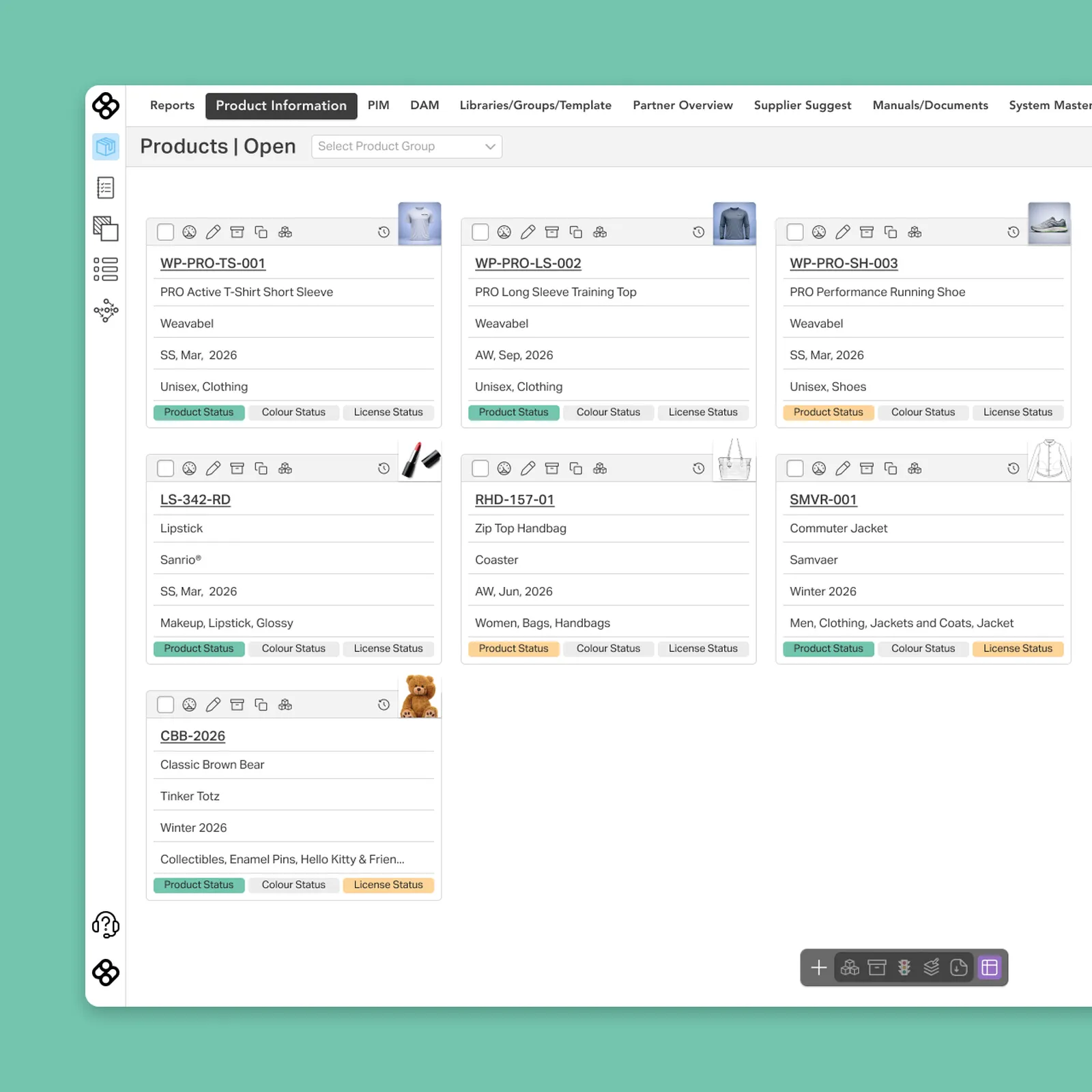
Manage your entire product lifecycle, from initial concept and design through to development, manufacturing and bringing it to shelves.
Automate your Digital Product Passports in a way that’s affordable, scalable and removes the need for multiple complex systems.
Unify all your product information with an automated PIM that ensures consistency and accuracy while reducing workload and manual data entry.
Organise, store and access all your digital assets into a single, easy-to-use hub so you can effortlessly find, share and use content whenever you need to.
In the world of electronics, the journey from a brilliant idea to a market-ready product is riddled with complexity. Regardless of the electronic product that you are developing, the margin for error is razor-thin.
Product Lifecycle Management (PLM) for electronics acts as the backbone of a product’s development journey. It enables product teams to take a strategic approach to product development that integrates people, data, processes, and business systems.
In this guide we cover everything you need to know about using a PLM for electronics product development.
PLM in the electronics sector is not just about managing the journey of a product from its inception through to its eventual disposal. It is about managing a multidisciplinary ecosystem of hardware, software, and firmware.
Traditional PLMs often have a focus on the mechanical attributes of a product such as the components that are used to make a hand whisk or a bicycle. In the electronics industry, this is simply not an approach that is complex enough.
Electronics PLMs must be able to integrate with Electronic Design Automation (EDA) tools in order to manage schematic captures, report on integrity data, collate PCB layouts, and more. Connecting to a traditional CAD software is not enough.
There are key challenges in electronics product development that a PLM must be able to handle.
Electronics products contain numerous components with many products consisting of hundreds of tiny commodities. The best PLM for electronics companies will allow for a heavy focus on Electric Component Management (ECM).
ECM is extremely important for electronics product development, due to rapid innovation cycles within the industry.
Electronics chip manufacturers such as NVIDIA and Intel are constantly creating new improved chips on a 12 to 18 month basis. This results in older chips becoming obsolete more quickly, pushing them into the end-of-life phase of product development much faster than before.
There is also the issue of market dominance to contend with. If one of your products uses a component that an international phone manufacturer stops using, your supplier may stop making it altogether, leaving you with a big problem if you are not prepared.
A PLM for electronics will flag these changes to a component before it becomes an immediate issue. This enables you to solve the problem proactively, without disrupting the product development timeline.
Regulatory compliance for electronics companies is a complex moving target that can vary dramatically by country or region. Failing to navigate this landscape doesn’t just result in fines; it can lead to total market exclusion and very expensive product recalls.
The landscape is constantly changing too with requirements such as Digital Product Passports (DPP) becoming mandatory in the EU.
There are already several regulations that originated in the EU that have been adopted by nearly every major economy too:
Adherence to these regulations and any further emerging regulations is paramount to ensuring that an electronic product is market ready. If a PLM can’t manage this constantly changing data, it will not be viable for use with electronics product development.
There are 3 big challenges that product development teams within the electronics industry face:
Using a PLM for electronics can help to solve the 3 big challenges challenges in the following ways:
Friction between teams originates from different teams working in silos. This results in physical issues with a product only being uncovered when the first physical prototype is built. This results in lost time and unnecessary cost due to wasted materials.
The best electronics PLMs catch these issues early by allowing ECAD and MCAD data to be synchronised. This allows for virtual checks of a prototype with AI-driven validation to flag any issues before any time or money is spent on physically creating it.
Without good supply chain visibility, an engineer will solely base their choice of components on technical specs. This can lead to them choosing components that are nearing the end of their lifecycle or that have an extremely long lead time.
A good PLM will connect directly to EPR systems or a global component database to provide real-time risk scoring for all components of a product that is in development. This enables engineers to take component risk levels into account when designing a product.
The inclusion of approved manufacturer lists and approved vendor lists within a PLM can help to navigate supply chain issues too. If a primary supplier fails, the procurement team can switch to a pre-approved alternative without the need for approval from engineering.
Engineers spend up to a third of their time on non-value-added tasks that can be automated with PLM.
Source: https://resources.sw.siemens.com/en-US/video-what-are-the-main-business-benefits-of-plm-and-roi/
The main cause of bottlenecks and delays in any product development process is the approval process. If approvals are handled through email chains with no audit trail, things can get missed and the development process can grind to a halt. The longer these delays take, the more likely it is that a product’s development will be abandoned altogether.
A PLM takes care of the approval process without the need for external communications between teams. As soon as approval is needed at any stage in the product development process, the right stakeholders are notified immediately.
They can then either provide approval or leave real-time comments about requirements for approval which will be available to the entire product development team. This reduces approval timelines dramatically and results in fewer abandoned projects.
IBM reduced the number of abandoned projects from 25 percent to just one percent over an eight-year period using PLM.
Source: https://public.dhe.ibm.com/software/plm/uk/electronics_en.pdf
With the EU’s Digital Product Passport requirements now in full effect, Bombiix automates the collection of sustainability and material data, making compliance a seamless part of your workflow rather than a last-minute hurdle.
Unlike traditional PLMs that often have costs hidden behind invisible tiers and success metrics, our solution has a number of transparent subscriptions to choose from.
We don’t punish you for success by massively increasing our prices when you add a certain amount of SKUs to your PLM software. Our solution grows alongside your company.
Learn more about PLM sectors
The Bill of Materials must include and integrate hardware, software, firmware, and packaging data.
Enabling engineers to reuse pre-approved components with known footprints and verified symbols.
Scan a design for common design or development errors.
Warning if a part is not recommended for new designs or at the end of its life.
Capable of flagging components with high lead times or limited available suppliers.
The system must automate the generation of technical files for multiple international regulations, and include substance tracking and carbon footprint tracking.
vendors and suppliers should be able to access the parts of the PLM they need without gaining full access to your internal IP.
Most traditional PLM systems fall short for the electronics industry due to their rigid design. They are much more effective at managing the development of simpler products such as valves and heavy machinery.
Legacy PLM systems simply aren’t agile enough to keep up with the fast paced world of electronics product development.
While legacy PLM systems were built to manage mechanical parts and static files, Bombiix was born out of a different reality. Our founder, Lucy Blackley, built this platform after years of frustration with disconnected systems, outdated spreadsheets, and “robotic” software that hindered rather than helped the creative process.
Our platform is designed specifically with product teams in mind. It is developed to work alongside your existing workflow seamlessly. You don’t have to change your approach to fit our software. It changes to fit your approach.
Bombiix is intuitive, visual, and mirrors the actual creative flow of electronics development. We focus on reducing “busywork” so your engineers can focus on innovation.
Legacy PLM implementations can take more than 12 months due to dev reliance and old-fashioned data importing. With Bombiix this is not an issue.
Our platform is cloud-native and designed for rapid onboarding. We typically get teams up and running in a matter of weeks rather than a matter of months. Our onboarding process is supported through direct face to face calls with real people and real-time chat too. You won’t be left waiting on a support ticket that has no connection to a real person.
Get Started with Bombiix today
Ready to get started with Bombiix?
Let’s transform your product data together!
Schedule a Free
60 minute Demo
Book a customised demo to see if Bombiix would be a good fit for your business.
Today, Bombiix empowers product teams with cutting-edge, affordable technology that simplifies processes, reduces admin, and enables smarter, more ethical decisions.