Ian Brown
We invested in Bombiix because we recognised the strength of its PLM offer and the impending EU requirement for Digital Product Passports.
With decades of experience investing in SMEs – from starting at 3i, to opening the Bahrain Development Bank and now co-owning Anticus – I’ve seen the challenges businesses face and the opportunities that come with them. Our role is to be a supportive investor, guiding Lucy in growing Bombiix and in future fundraising.
Sue Page
With experience across manufacturing, financial services, SaaS, e-commerce, and retail, I help Bombiix navigate growth while keeping a close eye on cash flow, performance and strategic alignment.
From the first time I met Lucy, I knew I wanted to work with her – she’s a breath of fresh air and the passion that fills her is infectious. It’s a pleasure to complement her skills in delivering the vision of Bombiix.
Zowaid Rauf
I make sure our software meets your needs, spotting areas for improvement and helping your team streamline and grow.
Having worked in hospitality, manufacturing, supply chain and agriculture, I bring a wealth of experience when it comes in creating digital solutions that tackle real-world challenges.
Neil Weaver
I joined Bombiix after being a customer – it’s hugely refreshing to see a platform that focuses on the needs of product people. After managing many global teams across multiple industries, including pharmaceuticals, FMCG, toiletries and cosmetics, sporting goods and apparel and fashion, I can see real potential in Bombiix, and I’m excited to lead the business and achieve it.
Lucy Blackley
I created Bombiix because I was an exhausted, frustrated Head of Product who knew there had to be a better way to work
My experience is in garment technology, pattern cutting, product development and technical design and I understand the everyday struggles our customers face – the chaotic workflows, confusing email threads and out of date spreadsheets. So I created Bombiix to change all of that.
Why Bombiix?
The concept for Bombiix was born from one product developer’s frustrations with outdated legacy PLMs. So, when we say we get it, we really do. Whether you’re a growing start up or experienced enterprise, our team is with you every step of the way with personalised onboarding and ongoing support. My experience is in garment technology, pattern cutting, product development and technical design and I understand the everyday struggles our customers face – the chaotic workflows, confusing email threads and out of date spreadsheets. So I created Bombiix to change all of that.
Manage your entire product lifecycle, from initial concept and design through to development, manufacturing and bringing it to shelves.
Automate your Digital Product Passports in a way that’s affordable, scalable and removes the need for multiple complex systems.
Unify all your product information with an automated PIM that ensures consistency and accuracy while reducing workload and manual data entry.
Organise, store and access all your digital assets into a single, easy-to-use hub so you can effortlessly find, share and use content whenever you need to.
Finding the best PLM software comes down to one thing: does it actually work for your team?
The right platform connects your people, centralises your product data and removes the admin that slows everything down. This guide walks you through what to look out for and how the leading PLM options compare.
Some PLM systems just add more complexity. A genuinely useful one makes things simple and understands how you and your team work.
Product development can already be a beautifully creative and chaotic process, without the tools you rely on adding more unnecessary stress to your day-to-day life. A clunky system that doesn’t fully line up with how you work has a detrimental domino effect across your entire operation:
Colleagues who can’t quite make the PLM work for them are forced to conjure up their own processes and workarounds. Product data is spread across different systems and spreadsheets. Suppliers are disconnected, and details get missed in long email chains.
And, after all that, you still end up paying the hefty price tag each year for a system that simply isn’t offering much value to your team.
Below are some things to look out for when deciding on the best PLM software for your business.
When your BOMs, specs, costings and product data live in different places, inconsistencies become expensive mistakes.
Someone approves a sample against an outdated spec. A supplier quotes on the wrong quantities. The costing of a product gets rebuilt because no one trusted the last version.
The best PLM software puts every piece of product data in one connected place, updated live, so whoever looks at it - whether that's a designer, a buyer or a supplier - sees the same accurate picture.
There’s no more second-guessing or chasing the "latest" version.
A powerful system is only useful if your team actually uses it.
Complex, clunky interfaces are one of the most common complaints against enterprise PLM tools. If your team needs a training manual just to raise a purchase order, the software is working against you, when it should be working for you.
Look for a platform that feels intuitive from day one - clear navigation, plain language, and a layout that mirrors how your team actually thinks about product, not how a software engineer thinks about databases.
Designers, merchandisers, sourcing teams and suppliers across different time zones all need visibility of the same information, often on the same day. When collaboration lives in email threads instead of your system, updates get lost, feedback gets duplicated, and delays creep in.
The best PLM platforms bring internal teams and external suppliers into one shared environment, with comments, approvals and version history all attached directly to the product.
This matters even more for fashion and lifestyle brands managing global supply chains, where a missed message can mean a missed delivery window.
Many legacy and enterprise PLM tools are powerful, but rigid. If you need a new field, a different workflow or a custom template, you're often stuck waiting on a development team, and paying for the privilege.
That’s frustrating and costly for fast-moving product teams.
Configurability should be in your hands, not something you have to request. The best systems let you build custom fields, statuses and modules yourselves, so your PLM evolves alongside your business rather than holding it back.
With dozens of PLM platforms on the market, it’s no surprise that overwhelm kicks in when choosing the right one for your business.
It often feels like each software has near-identical descriptions, all promising the world and boasting a huge list of features you’re not sure you even need.
We’ve been where you are - our team has lived your day-to-day life, working as product developers, garment technologists and operations managers before creating our own PLM.
Here’s a straightforward breakdown of what the most popular options offer product teams today (in alphabetical order):
A cloud-based, mid-tier PLM platform best known for being easier to onboard and use than most enterprise competitors. Consistently praised for usability, intuitive interface, easy document control, and fast search/retrieval, which makes it a good fit for smaller businesses wanting to avoid a steep learning curve.
However, some reviews also flag a dated, somewhat clunky interface, separated workspaces for items/docs, limited homepage customisation, and difficulty uploading multiple files at once.
Pricing isn’t published.
Electronics, industrial, and mechanical/hardware manufacturers.
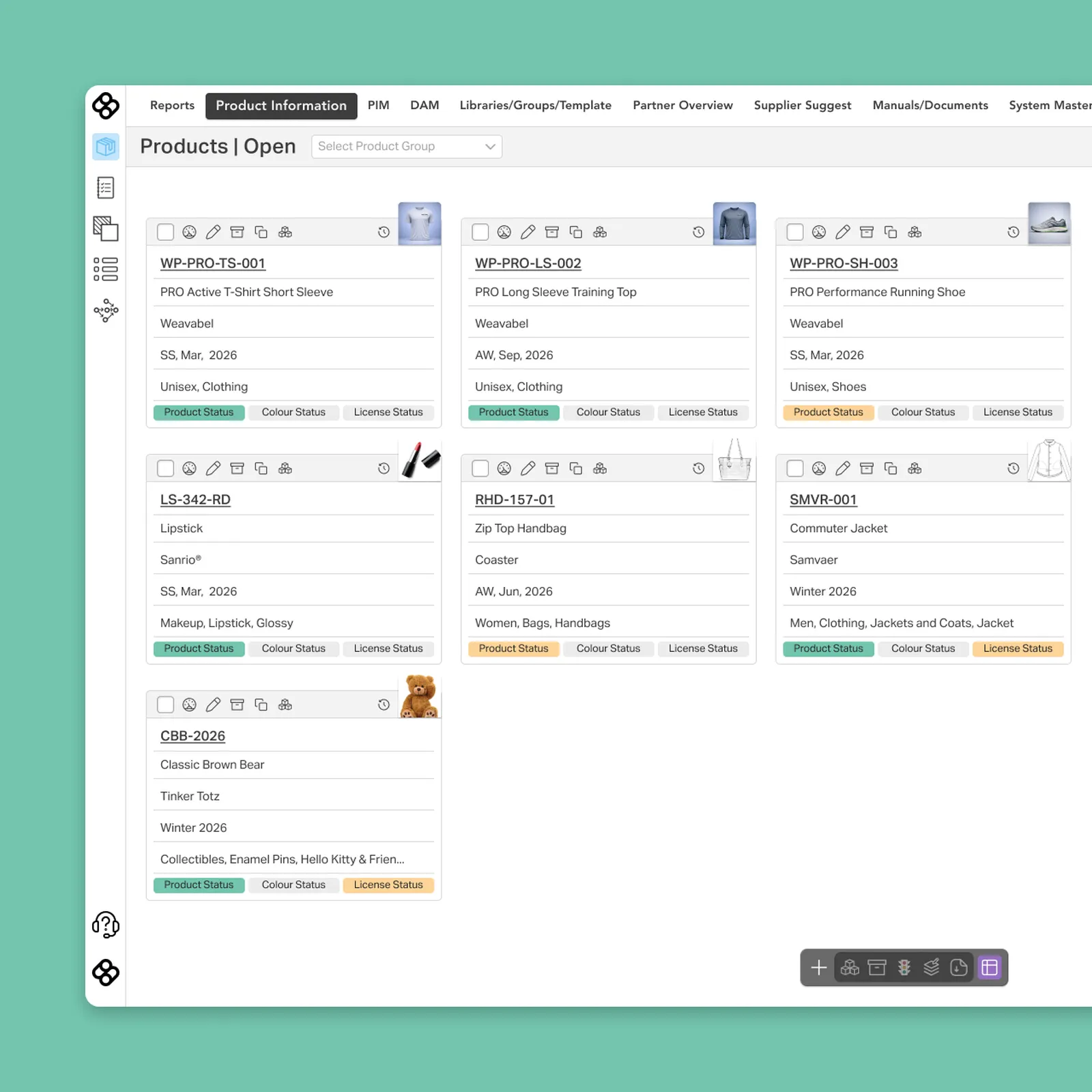
Bombiix is a powerful people-centred Product Lifecycle Management software (PLM) that places you at its heart, managing every stage of your product development process with clarity and efficiency every single time.
It’s a cloud-based PLM with built-in PIM (Product Information Management), DAM (Digital Asset Management) and automated Digital Product Passports with AI-powered, human-qualified carbon impact in one connected system.
Everything a product team needs lives in one place and updates live - tech packs, BOMs, specs, costings, sampling, testing/compliance, purchase orders, supplier management, critical paths, and both top-down and bottoms-up planning - so there's a genuine single source of truth instead of scattered spreadsheets and disconnected tools.
The platform is designed by people who have lived and breathed product development, working as product developers, operations managers and garment technologists.
This has resulted in an intuitive, easy-to-use and configurable platform with fast onboarding that’s supported by live chat and calls directly with the team.

Starts from £200 per user per month.
SME businesses in any consumer goods sector, businesses looking to scale PLM as they grow and also large businesses that have got frustrated by the costs and complexity of legacy PLM.
Centric is an enterprise platform that is widely adopted across fashion, retail and consumer goods. A solid choice for large organisations with complex, established processes.
Its main strengths are breadth and maturity, with a broad feature set, strong integrations with ERP, CAD and supply chain systems, plus colour management, global search, and merchandising/planning tools.
However, some users report that navigation and configuration can feel complex and not especially intuitive, data imports are somewhat inflexible, large datasets or bulk uploads can be cumbersome, and customisation/support costs can add up quickly if you're not careful.
Pricing isn’t published - it’s quote-based and scales with users, modules and configuration.
Larger, more complex fashion/retail organisations who can absorb a heavier implementation and ongoing cost.
A mid-market and lightweight PLM solution that prioritises ease of use and fast deployment. Delogue is praised for being genuinely user-friendly and quick to get up and running, which makes it appealing for small teams just starting out. The trade-off is scalability - as ranges and teams grow, some brands find themselves outgrowing its functional depth and facing a costly re-platform down the line.
Pricing is published, starting from €145/user/month.*
*Correct at time of publishing
Mid-market and lightweight teams.
FlexPLM offers real scalability and depth for large, global businesses with complex product portfolios, and counts some of the biggest names in fashion and footwear among its users.
The trade-off is a reputation for a complex user experience and a slower time-to-value, according to some reviews, which can be a difficult fit for product teams who need to move quickly and get their whole team using the system with minimal training. PTC has recently added AI capabilities to automate tech pack creation, though it's still catching up to more AI-native, purpose-built platforms in this area.
Pricing isn’t published - it’s quote-based.
Large, well-resourced retail/fashion/footwear enterprises with complex, multi-brand or multi-category portfolios.
Siemens Teamcenter is a well-established, enterprise-grade PLM platform built for discrete manufacturing - engineering-heavy industries with complex, multidisciplinary products.
Deep, comprehensive functionality across design collaboration, engineering change and BOM management, multi-CAD integration, end-to-end traceability, workflow automation, digital twin visualisation, supplier collaboration and compliance. It's known for tying together mechanical, electrical, software and manufacturing data into a genuine "digital thread."
Setup often benefits from dedicated IT support, and the sheer breadth of Siemens' portfolio can make total cost of ownership hard to pin down, especially when moving to cloud/SaaS. It's built for "well-established manufacturers," not teams wanting to move fast with minimal onboarding.
Pricing is not published, and is completely quote-based.
Experienced manufacturers with complex, engineering-heavy products who need a serious, all-encompassing PLM backbone.
Fashion and lifestyle brands have needs that generic PLM tools - and even some fashion-specific enterprise systems - don’t fully address.
Nowadays, development cycles are short, suppliers need clear, fast collaboration across timezones and there’s an increasing requirement for accurate sustainability data.
Bombiix is designed to support all of that in one simple subscription.
Tech pack creation, prototyping and sampling, Bill of Materials and Digital Product Passports all live inside one connected system, so a change in one place updates everywhere it matters. Suppliers collaborate directly rather than through email chains, and your team spends less time chasing updates and more time on the product itself.
For small to medium fashion and lifestyle brands who've felt overlooked by enterprise-first platforms, Bombiix is built specifically with you in mind.
Find out more about our PLM for fashion companies
Manufacturing-focused product teams have their own priorities: accurate, structured Bill of Materials, clear change management and full traceability, integration with ERP and CAD systems, and reliable quality control. Getting any of these wrong is costly - a missed spec change or an untracked component swap can ripple through an entire production run.
Bombiix supports this with detailed, customisable BOMs that trace all the way to Tier 4 sourcing, built-in testing and compliance tracking, and API access for connecting to your ERP or CAD systems of choice. Every change is logged, so you always know what changed, when and why.
Find out more about our PLM for manufacturing
Your PLM system is at the heart of your product development, and has a rippling effect across your entire business, impacting speed to market, resource costs, compliance, your team’s productivity and creativity and - ultimately - your profitability.
Choosing the right PLM is a big decision. Here’s a practical framework you can get started with:
Will this system fit you in two years, or will you outgrow it?
Does it understand the specifics of your sector, whether that's fashion, lifestyle or manufacturing?
How quickly can your team realistically get up and running? Will it disrupt your timelines?
Does it connect cleanly with your ERP, CAD, PIM, ecommerce and supplier systems?
Can you adapt it yourselves, or are you reliant on a development team?
Will you get responsive, knowledgeable help when you need it?
What's the real cost, including implementation, customisation and scaling?
.
.
.
.
.
.
We've been in your shoes. Bombiix was designed with product people at its core, not bolted on as an afterthought to an engineering-first system. That means a genuine single source of truth, workflows that feel natural from day one, and a custom module builder that puts control back in your hands - no development queue required.
Whether you're a COO looking to bring structure and cost clarity to your operations, or a product developer who wants a system that supports you rather than one you have to constantly adapt to, Bombiix grows with you. You get enterprise-level capability - PLM, PIM, DAM and Digital Product Passports in one place - without the enterprise-level complexity or price tag.
Ready to see it for yourself? Book a free demo and find out what Bombiix can do for your team.
Get started with Bombiix today
Ready to get started with Bombiix?
Let’s transform your product data together!
Schedule a free personalised demo
Book a customised demo to see how Bombiix can streamline your product development process.
Bombiix empowers product teams with cutting-edge, affordable technology that simplifies processes, reduces admin, and enables smarter, more ethical decisions.