Fast, Efficient Product Lifecycle Management | Bombiix

PLM for Toys: The Complete Guide to Product Lifecycle Management in the Toy Industry

Product Lifecycle Management (PLM) for toys allows product teams to transform a creative idea into a safe, compliant toy on store shelves. It helps to take the stress out of toy-making, by taking the complex production journey of a toy and managing centralised information to simplify compliance and regulatory processes.

What is PLM and why do toy companies need it?

In simple terms, a PLM is the “digital brain” for your business. It is a single centralised platform that stores every piece of information about a product. PLMs are designed to store information about a product through its entire life cycle, from the very first sketch to the final safety certificate.

The importance of lifecycle information for a toy is extremely important because the process blends creativity and engineering precision into a single complex journey, with the final product needing to adhere to a number of safety standards.

Due to the complexity of a toy’s product lifecycle, relying on traditional methods for data storage and sharing can create a minefield of hidden costs and human errors. Data becomes fragmented and timelines get longer and longer before a toy is fit to be on store shelves. 

This is where a PLM for toys can improve your processes and have a positive impact on the efficiency of your team’s workflow.

Unique challenges in toy product lifecycle management

Safety compliance and regulatory requirements

Safety in the toy industry is not just a check-box to fill at the end of a toy’s production. Toy safety compliance is multi-layered. It dictates every material selection and design choice throughout the process. There is a need for a toy to adhere to multiple global standards such as EN71 (Europe), ASTM F963 (USA), and ISO 8124 (International) which can place a big administrative burden on a toy’s launch. 

If these are not managed with precision, the launch of a new toy can be completely derailed. Using manual systems to store data on mechanical testing, chemical and toxicological compliance, and flammability standards is very demanding, and leaves room for human error that can cause non-compliance of a product.

Seasonal product cycles and tight deadlines

The toy industry doesn’t just have tight deadlines, it has a single quarter (Q4) of the year in which the vast majority of annual sales occur. If a new toy is not launched within this quarter, it will have to sit in a warehouse for a year until it can be launched in Q4 of the following year.

There is no such thing as a late release for a toy. This applies pressure on toy companies to keep their development cycles short, in order to hit seasonal peaks. Efficiency is a must. 

Traditional data storage practices do not help to enable the required level of efficiency to get a toy launched within such a tight lifecycle. This is where the best PLM for toys can make the biggest difference.

Managing complex supply chains and sourcing

The development process for a toy is not just a case of creating a single item. Most toys are assembled from multiple components such as molded plastics, electronic chips, and synthetic textiles. This requires the use of multiple suppliers across multiple countries which can pose significant challenges.

To ensure that the development of a toy is efficient and runs smoothly, the right components need to be available at the right time. This means that all suppliers need to be active within the process at the right points to work in harmony together. 

Trying to manage this manually can quickly cause issues due to missed details that can put the rest of the process on pause. Not only does this delay the launch window for a toy, it also puts strain on the relationships your company has with its suppliers.

Key features every toy PLM system should have

There are a few key features that a PLM should have, to make it effective for use within the toy development process. 

  • Dynamic Bill of Materials (BOM)
  • Critical path management with milestone alerts
  • Technical specification & version control
  • Direct supplier and factory collaboration
  • Digital Product Passport (DPP) readiness
  • DAM and PIM integration

These features are important for 2 parts of toy ‘product development’; design, collaboration and creative workflow management, and compliance tracking and testing management.

Design collaboration and creative workflow management

To allow for a product design team to work effectively with a truly efficient creative workflow, a PLM needs to have the following key features: technical specification & version control, direct supplier and factory collaboration, critical path management with milestone alerts, and DAM and PIM integration. We have detailed what makes each feature important below.

Technical specification & version control

A key feature that is used to keep everyone singing from the same hymn sheet, technical specification and version control  allows for the seamless management of CAD files, tech packs, 3D renders, and more.

This ensures that any changes to a toy are updated across all connected systems,preventing teams from having the wrong ‘source of truth’ and avoiding catastrophic errors such as a rejected prototype being used to create faulty products that are a waste of time, resources and money.

Direct supplier and factory collaboration

Because toy supply chains are global and involve multiple vendors, a PLM system needs to allow for collaboration via system integration. Instead of a product update being communicated through an email which can get lost in someone’s inbox, a supplier can make the update in the PLM system and every stakeholder within that toy’s development process will be notified.

Critical path management with milestone alerts

With all toy companies aiming for Q4 as their release window, there is a greater level of importance in working backwards from a retail launch window, and setting development deadlines based on it.

This kind of tight scheduling can be derailed easily by a single delay, especially if it is not reported on a system quickly. PLMs with critical path management and milestone alerts help to keep everyone on track, and notify all parties if any kind of delay has been registered. This allows timelines to be more agile with reduced knock-on effects due to delays.

DAM and PIM integration

While a PLM can manage the lifecycle of a toy’s product development, it can not do everything on its own. To allow for the effective management of digital visual assets, it must be connected to a Digital Asset Management (DAM) system, and to allow for all product data to be collated into a product profile that is formatted for different stores and vendors, a PLM must be connected to a Product Information Management (PIM) platform too.

This allows for all digital assets to be found easily when creating a new toy, which makes the product development timeline shorter. It also makes it easy to push final product information for listings and packaging to the multiple stores and vendors, without the need for data to be rewritten for each specific store.

How PLM transforms toy development processes

From concept to prototype in record time

The product development process hits the most friction at the point of creating a testable prototype, based on an initial idea. This is due to the increased number of manual handovers that are required. 

An effective PLM solves this issue by implementing real-time annotation of a product that is in development. This allows stakeholders to make decisions more quickly and communicate suggested changes without having to rely on emails that are not part of the product development loop.

A PLM can also calculate the costs attributed to the development of a product throughout the prototype phase. If the materials used to create a prototype are too costly, or if a product will just be too expensive to make, you can see this before a physical sample is created. This helps to save on money and wasted time on further rounds of prototyping.

Streamlined communication across teams

The traditional approach to product development often has communication silos that are created by the gatekeeping of data. Different teams work in different systems and nothing is connected properly. This results in information gaps between teams which hits efficiency, and results in friction between different departments.

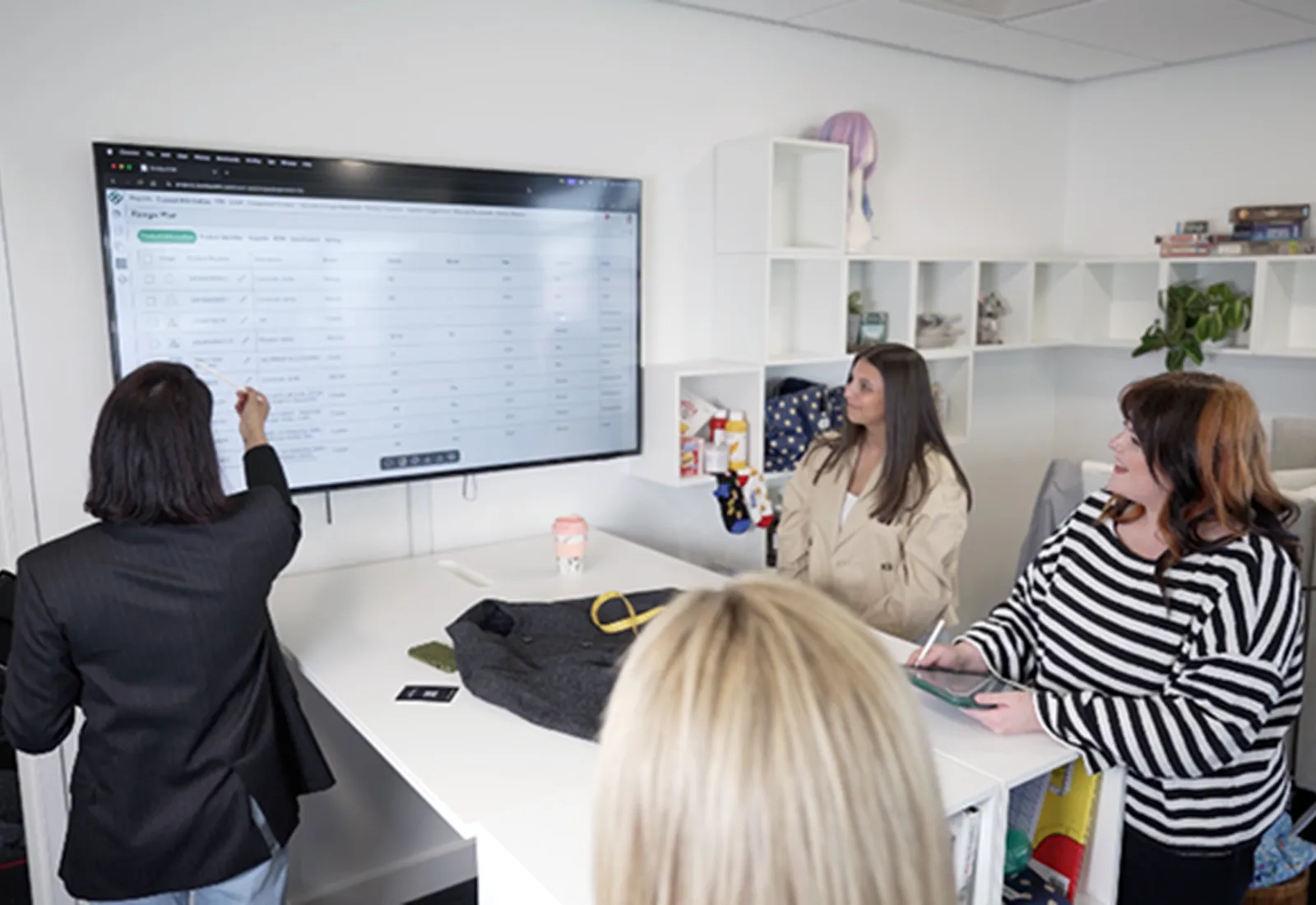
A good PLM acts as the single source of truth for all members of a product development team, regardless of which department they work within. Everyone sees the same thing in real-time, and there is no confusion about which file is the right one to use. This makes cross-team communication much smoother and results in more efficient workflows for everyone involved.

Cloud-based design tools enable multidisciplinary teams at toy companies to work concurrently, creating significant efficiencies throughout the product development process. Source: https://www.digitalengineering247.com/article/engineering-toysto-infinity-and-beyond

Why Bombiix is the best PLM for toy companies

Unlike traditional PLM systems that are structured and rigid, Bombiix is an agile ecosystem designed specifically for product people, by product people. It is an excellent fit for the high-velocity, high-compliance world of toy development.

Built by product people who understand toys

We are acutely aware of the difficulties that toy companies face when developing their products, and our solutions are designed to solve them.

The challenge of a single product consisting of multiple components requires more than a static, standalone solution that treats a toy as a single line item. 

Our PLM, PIM, DAM, and DPP ecosystem connects all product data together, and centralises it to create a robust product profile for each toy. This makes every product that you develop audit-ready. 

If the material of a component changes, the information is updated across all systems with no need for manual fixes. 

Milestone notifications help to keep the development of a product on the critical path with fewer delays that have less impact, and our solution doesn’t take months to implement. 

No hidden costs or complex implementations

Many traditional PLM vendors provide tiered pricing that punishes you for success. The moment your company’s growth hits a certain level that moves you up a tier, the cost of your PLM solution increases dramatically.

At Bombiix we don’t believe in punishing success. Our transparent pricing model has subscription levels based on user numbers, and that’s all there is to it. No hidden fees or dramatic price increases, our subscriptions simply scale with you.

Traditional PLMs are also difficult to implement quickly. They often need a lot of information to be uploaded manually, with a lot of help from dev teams to get things up and running.

Our quick implementation is fully supported by product people within our team, who are easily available through live-chat services and real-time calls. Instead of taking months to set up your PLM, we can get you up and running in a matter of weeks.

Learn more about PLM sectors

Loved by product people, trusted by..

PLM for Toys FAQs

A toy PLM needs to be able to handle all of the components that are used to create a single toy, effectively. It must be able to handle information on different materials, suppliers, and compliance regulations, and centralise them into a single product profile that contains all of the required information for that toy. General PLMs are often too rigid to do this, and are not able to connect different pieces of information together.

Depending on the PLM you go with, the implementation of a toy PLM can take several months. Especially if you choose a traditional PLM. With the Bombiix PLM, you can be up and running in a matter of weeks.

Yes, small toy companies can benefit from PLM software. Especially if they pick an agile PLM like Bombiix that will scale with them, without introducing dramatic cost increases at certain success milestones.

The return on investment for a toy company when investing in a PLM will mostly be based around time and security. With Bombiix PLM, your team will spend less time looking for files, rewriting product information for different vendors, and chasing compliance information, and spend more time actively developing new toys. You will also get the certainty that your toys will be DPP compliant before the EU deadline, and that no product will be released until all compliance and safety regulations have been met.